Preserving History: The Importance of Omani Sarooj
Learn about the cultural significance and importance of Omani Sarooj, the traditional material used in the construction of old buildings and forts in Oman. Discover how our company is dedicated to preserving this ancient art and heritage.
Preserving History: The Importance of Omani Sarooj
By: Eng. Abdulaziz Al Maqbali, GM & Co-Founder MECC
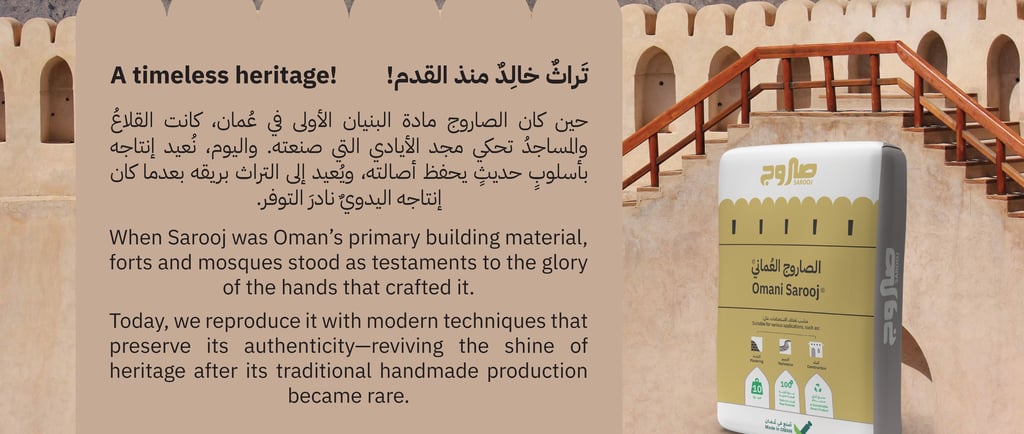
If you have ever stood before the towering walls of Nizwa Fort or walked along the ancient corridors of Bahla Castle, you have already felt the presence of Omani Sarooj. That warm, earthy texture beneath your fingertips is the very same material that has protected this nation for more than a thousand years. It is the reason our ancestors built structures that did not simply survive but thrived through centuries of invasions, floods, and scorching summers. And today, it is the very same material we trust to carry that legacy forward.
Omani Sarooj is not cement. It never tried to be. Traditional Sarooj is a hydraulic lime mortar, made from calcined clayey limestone, and its beauty has always been in its simplicity. When the old masons mixed it by hand and applied it to fort walls, they knew something that modern construction forgot for a while. They knew that buildings need to breathe. They knew that a rigid wall cracks under pressure, but a flexible one endures. That is why the castles of Oman did not just fall apart like so many other ancient structures around the world. That is why they still stand, proud and unshaken, as if time itself asked for permission before touching them.
But history is fragile. For decades, as modern cement became cheaper and faster to use, the art of making authentic Omani Sarooj nearly disappeared. The old kilns shut down. The master craftsmen grew old without passing their secrets to a new generation. And many restoration projects, sadly, began using the wrong materials, covering ancient stones with hard cement plasters that trapped moisture and caused more damage than they ever prevented. The irony was painful. In trying to save our heritage, we were slowly killing it.
That is why the work being done today by the Middle East Calcined Clay Company in Sohar Industrial City is not just about manufacturing a product. It is about rescuing a piece of the Omani soul. We went back to the original formulas. We studied samples taken from centuries-old forts. We worked closely with the Innovation Industry Academy and the Ministry of Energy and Minerals to understand exactly what made the original Sarooj so effective. And then we did something our ancestors would have appreciated. We used modern science to perfect their ancient wisdom.
The result is a new generation of Omani Sarooj that behaves exactly like the old one but with consistent quality that traditional methods could never guarantee. Every batch is tested in our laboratory to ensure it has the right balance of hydraulic properties, breathability, and compressive strength. When a restoration team uses our Sarooj on a historic tower, they can rest assured that the material will age exactly as the original did, without cracking, without trapping salt, and without causing hidden decay behind the surface.
And here is the part that makes us truly proud. Omani Sarooj is not just good for history. It is also good for the future. The production process we use generates significantly lower carbon emissions compared to conventional cement. That means when you choose Sarooj for a restoration project or even for a new building, you are supporting Oman's national commitment to net zero emissions. You are building in a way that honors the earth just as much as it honors the ancestors.
More and more Omani homeowners and architects are discovering that Sarooj is not only for forts and castles. It works beautifully on modern villas, on feature walls, on garden courtyards, and on coastal homes where salt air destroys ordinary plaster within a few years. The natural earthy color of Sarooj gives any building a warm and authentic Omani character that cannot be faked with paint or artificial finishes. It looks like it belongs here because it does belong here. It came from this land, and it returns to this land.
Every time we produce a ton of Omani Sarooj, we think about the hands that built this country long before any of us were born. We think about the masons who mixed mortar under the sun while their children played in the shade of half-finished towers. We think about the families who lived inside those fort walls, sleeping soundly because they knew no enemy could break through. That same protection, that same durability, that same honest craftsmanship is available to you today.
Preserving history is not about freezing old buildings in time like museum pieces. It is about keeping them alive, keeping them breathing, and keeping them standing for the next generation of Omani children to touch with their own fingertips. Omani Sarooj is how we do that. It is our link to the past and our gift to the future. And it is ready to serve your next project, whether you are restoring a national treasure or simply building a home that you want your grandchildren to inherit.
Choose Omani Sarooj. Because some things are too precious to be left to memory alone.